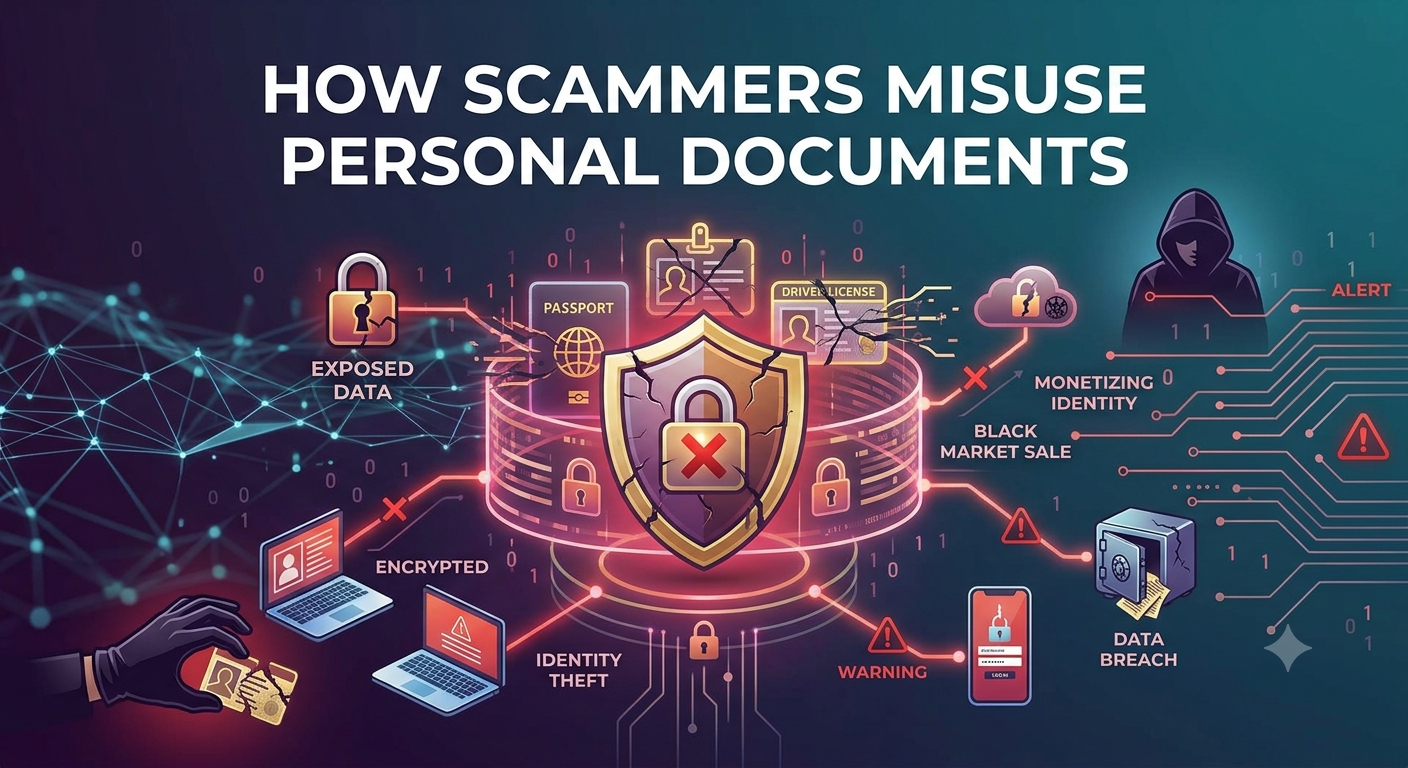
Most people imagine online fraud as some hooded hacker breaking into a bank server. In reality, the vast majority of identity scams begin with something far more ordinary — a single photo of your Aadhaar card sitting in someone's WhatsApp chat, an old resume floating on a job portal, or a boarding pass posted on Instagram. Scammers don't need to break in when we hand things over willingly, one document at a time.
Understanding how scammers misuse personal documents is the first real step toward protecting yourself. The tricks they use aren't always dramatic. They're quiet, patient, and often built on tiny pieces of information collected from many places. This article breaks down the exact ways criminals turn everyday documents into tools for fraud — and what you can do to stay one step ahead.
Why Personal Documents Are So Valuable to Scammers
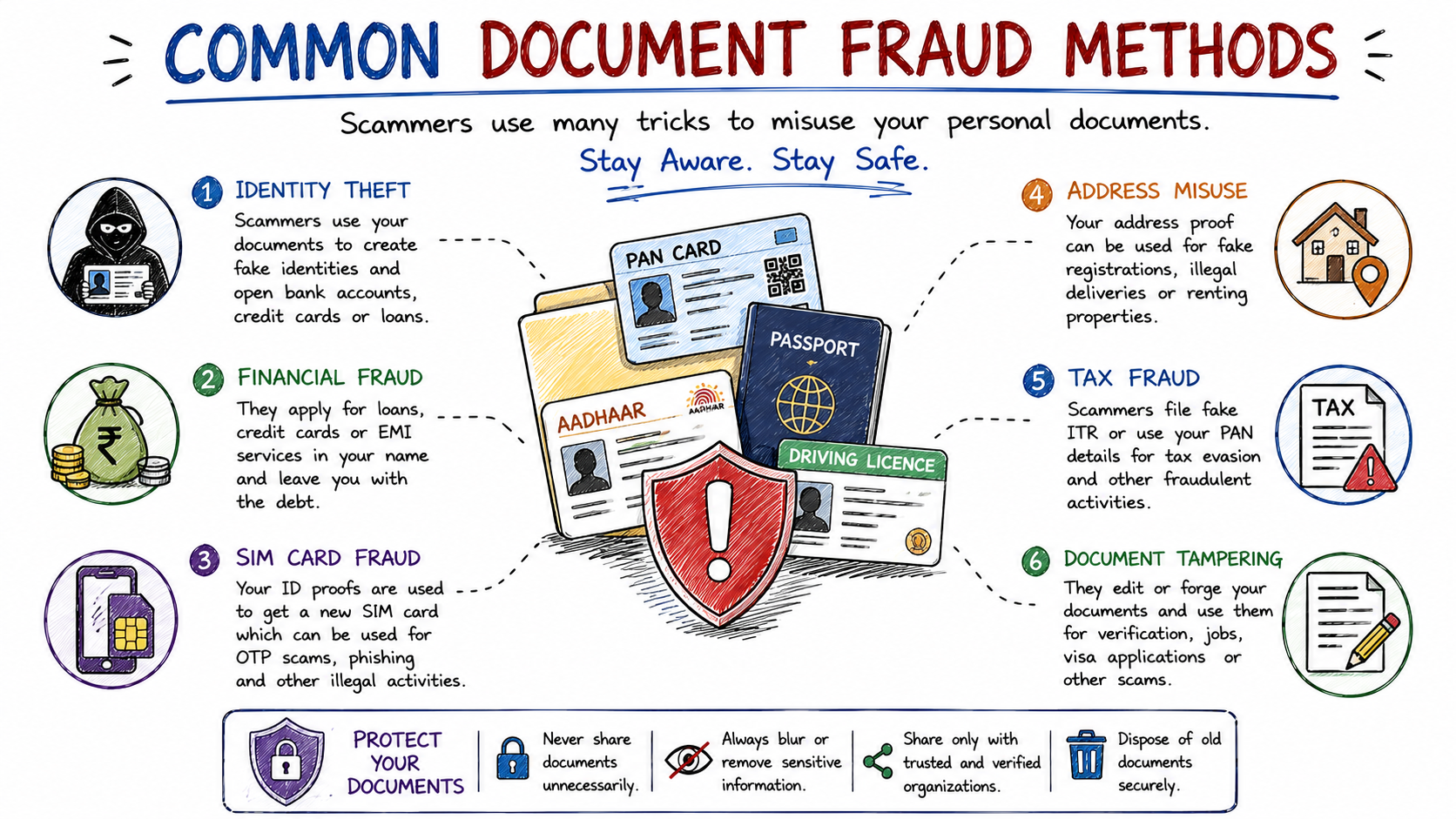
Your documents are basically the paperwork version of you. Your Aadhaar links to your biometrics. Your PAN links to your finances. Your passport unlocks travel and international verification. Your driving licence acts as universal ID proof. Even a plain electricity bill can confirm your address for shady loan applications.
What makes them so appealing to scammers is that they're permanent. You can reset a password in seconds, but you can't reset your date of birth or your Aadhaar number. Once a document leaks, it stays useful to fraudsters for years — and that's exactly why identity theft has quietly become one of the fastest-growing categories of online crime.
1. Creating Fake Identities From Real Documents
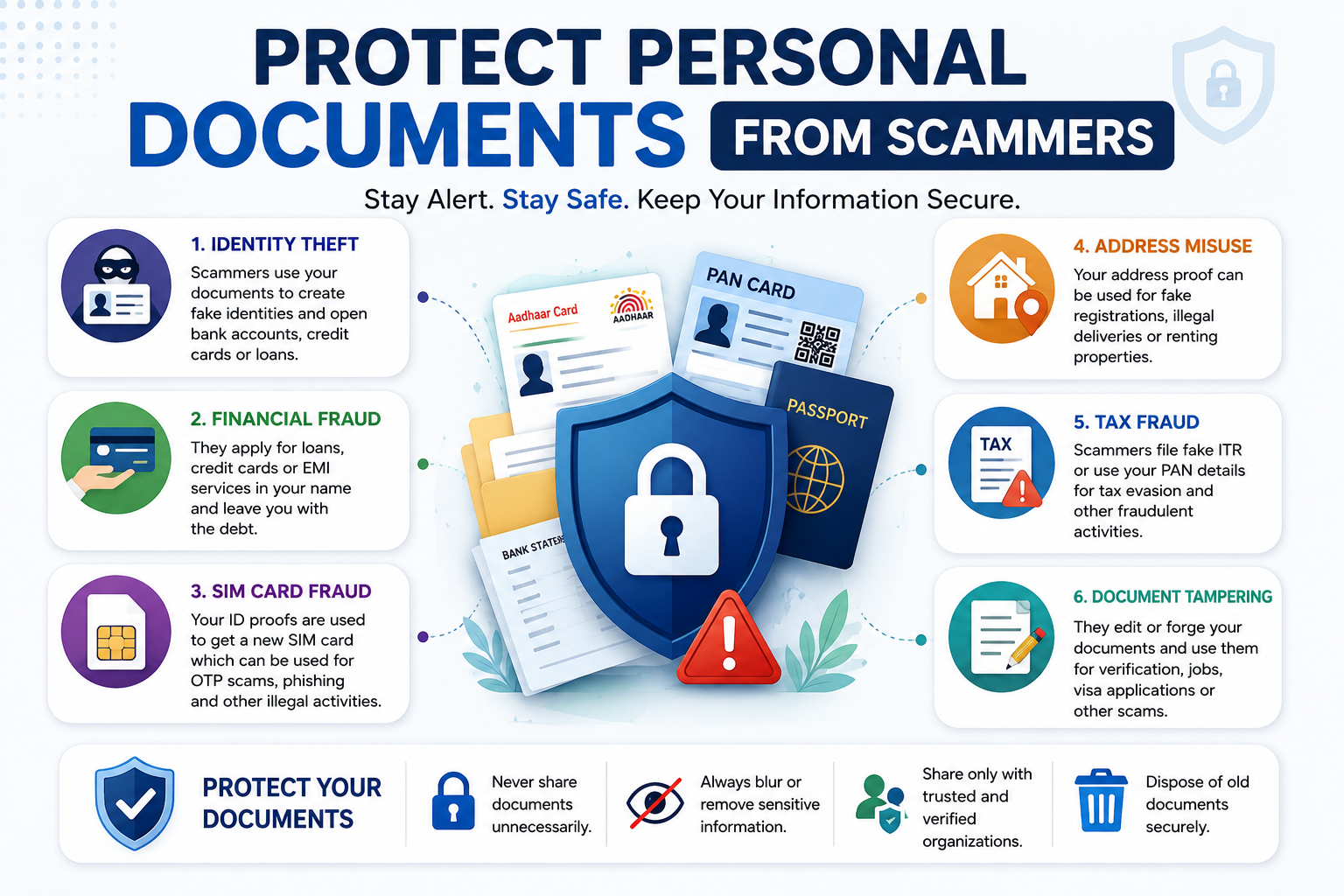
One of the most common ways scammers misuse personal documents is by building "synthetic identities." They take real details from your ID — name, DOB, photo, address — and mix them with fake elements to create a new person on paper. This fake identity is then used to open bank accounts, apply for loans, buy SIM cards, or even register shell companies.
The scary part? You often won't notice until months later, when a collection agency calls about a loan you never took, or a police notice arrives for an account opened in your name.
2. Opening Bank Accounts and Applying for Loans
A leaked Aadhaar plus PAN combo is basically a golden ticket in the wrong hands. Fraudsters use these to open digital bank accounts, apply for instant personal loans, sign up for buy-now-pay-later services, or activate credit lines through fintech apps that rely purely on document uploads.
Since many of these platforms only require a scanned copy for e-KYC, a scammer with a clean screenshot of your documents can often clear verification without ever needing you to be involved. By the time the fraud surfaces, the money is gone and your credit score is the one paying the price.
3. SIM Swap Fraud Using Leaked ID Proof
This is one of the sneakiest scams in circulation right now. A fraudster walks into a mobile store (or uses an online telecom portal) with a copy of your Aadhaar or driving licence and requests a "duplicate SIM." Once they gain control of your number, every OTP that lands on it — banking, UPI, email, social media — goes straight to them.
Within hours, they can drain accounts, hijack your WhatsApp, and lock you out of your own digital life. The trigger for all of this is usually just one shared document image sitting somewhere online.
4. Job Scams That Feed on Resumes
Your resume is a goldmine of personal data — full name, phone number, email, address, date of birth, education history, past employers, and sometimes even a photo. Scammers scrape resumes from job portals or receive them directly through fake job listings.
Later, they use this information to run highly convincing scams: fake HR calls, fake offer letters demanding "registration fees," and phishing emails that reference real details from your career history to sound authentic. This is exactly why so many job scams feel weirdly personalized.
5. Address Proof Fraud and Delivery Scams
Utility bills, rent agreements, and bank statements might feel boring, but scammers love them. They use these documents to prove a fake address, register fake businesses, redirect deliveries, or intercept official mail like debit cards and cheque books sent to your address.
There are also cases where fraudsters use leaked address proofs to reroute e-commerce orders bought using stolen cards — meaning your address ends up being used to receive stolen goods without your knowledge.
6. Passport and Boarding Pass Exploits
Posting a boarding pass on social media might feel like a harmless travel flex, but the QR code and PNR on it can reveal your full booking, contact info, and future travel plans. Some scammers use this to send convincing "flight cancellation" or "refund" phishing messages timed exactly to your trip.
Passport copies are even more dangerous. They're used for visa fraud, illegal border-related paperwork, or being sold on the dark web to buyers who need "clean" identity documents to move around undetected.
7. Deepfake and AI-Powered Document Misuse
This is where things get genuinely modern. Scammers now use AI to combine your leaked photo with fake IDs, generate deepfake videos for video-KYC verification, or clone your voice using audio scraped from social media. A stolen document plus an AI tool can be enough to pass certain automated verification checks.
This is why 2026 identity theft looks very different from what it did five years ago. It's no longer just about copying a card — it's about becoming a convincing digital version of you.
8. Selling Documents on the Dark Web
Not every scammer uses your document directly. Many simply sell it. Full "identity packages" — including Aadhaar, PAN, photo, phone number, email, and address — are sold in bulk on dark web forums for surprisingly low prices. From there, they get bought and reused by other criminals across the world.
Once your document enters this ecosystem, it can resurface years later in a completely unrelated scam. That's why leaks feel like a "problem that never really ends."
9. Social Engineering Using Real Details
Scammers with access to your documents don't need to guess anything. They call you, greet you by name, quote your correct date of birth, mention the last four digits of your card, and suddenly you believe you're actually speaking to your bank. That's social engineering — and it works because the details feel real.
The moment trust is built, they push you toward "verification steps," OTP sharing, or transferring funds. This is by far the most emotionally exploitative use of leaked personal information.
How to Protect Yourself From Document Misuse
The good news: you don't need to be paranoid, just intentional. A few habits go a long way:
- Always use Masked Aadhaar wherever possible.
- Watermark documents with a purpose like "For XYZ KYC only – July 2026."
- Never share IDs on WhatsApp groups, even trusted ones.
- Verify the recipient before uploading anything.
- Delete unused document copies from downloads and gallery.
- Check your credit report every few months for suspicious loans.
- Enable two-factor authentication on banking and email accounts.
These small steps make you a much harder target — and scammers usually move on to easier ones.
Final Thoughts
Scammers don't need to break into anything when we quietly hand over our documents through unsafe uploads, group chats, and social posts. Understanding how scammers misuse personal documents is genuinely half the battle. The other half is building a few careful habits and treating your ID files with the same seriousness you'd treat your wallet or house keys.
A single document may look ordinary. To the right criminal, it's a launchpad. Protect it accordingly.
Frequently Asked Questions
1. How do scammers actually get hold of personal documents?
Usually through phishing links, fake job portals, insecure websites, leaked databases, unsafe WhatsApp shares, or documents posted publicly on social media.
2. Can scammers really open a bank account with just my Aadhaar and PAN?
Yes, especially on platforms that rely on document-only e-KYC. That's why leaked ID combos are so dangerous.
3. What is a synthetic identity?
It's a fake identity built by mixing real details from a stolen document with fabricated information to create a "new" person on paper.
4. How does SIM swap fraud connect to document leaks?
Fraudsters use a copy of your ID to request a duplicate SIM. Once they control your number, every OTP goes to them.
5. Is it dangerous to post boarding passes on Instagram?
Yes. The QR code and PNR can reveal your full booking, personal details, and even future travel dates.
6. Can scammers use my resume against me?
Absolutely. Resumes contain enough personal data to fuel highly targeted job scams and phishing calls.
7. Are utility bills really useful to scammers?
Yes. They're widely used as address proof for fake account creation, delivery fraud, and identity verification bypasses.
8. How does AI make document misuse worse?
Scammers now use deepfakes and voice cloning to bypass video-KYC and impersonate victims more convincingly than ever.
9. What's the single biggest habit that protects my documents?
Sharing only masked, watermarked, and purpose-specific versions of your documents with verified recipients.
10. How can Digital Safety Checker help me?
It helps you evaluate the risk of sharing a document before you send it, so you know exactly what could go wrong — and how to fix it first.
Don't Let a Simple Document Turn Into a Big Problem
Use our free Digital Safety Checker to see whether your document is safe to share, spot hidden privacy risks, and get quick recommendations before your file goes out.
Check Your Safety Score
Sameer Pal
Sameer Pal is a Content Writer specializing in online security, digital privacy, cyber awareness, and social safety. With over 3 years of experience, he creates practical, easy-to-understand content that helps readers recognize online threats, protect their personal information, and make safer decisions on the internet. His goal is to provide accurate, trustworthy, and user-focused guidance that promotes digital awareness and everyday online safety.
Featured Articles
Before Sending a Screenshot, Read This First
Simple, practical ways to share your Aadhaar safely while keeping your identity and personal information protected.
Read Article
10 Common Online Sharing Mistakes You Should Avoid
The most common online privacy slip-ups people make every day — and easy ways to steer clear of them.
Read Article
Best Practices for Safe Online Sharing
Follow these essential privacy habits to protect yourself while using social media and messaging apps.
Read Article